Psychiatry
About Course
Psychiatry
A professional learning pathway covering cancer care principles, clinical reasoning, screening concepts, staging awareness, oncology referral logic, patient communication and portfolio-supported continuing education.
Psychiatry – Master Specialization Certificate
Program Introduction
Start Anytime – Study at Your Own Pace
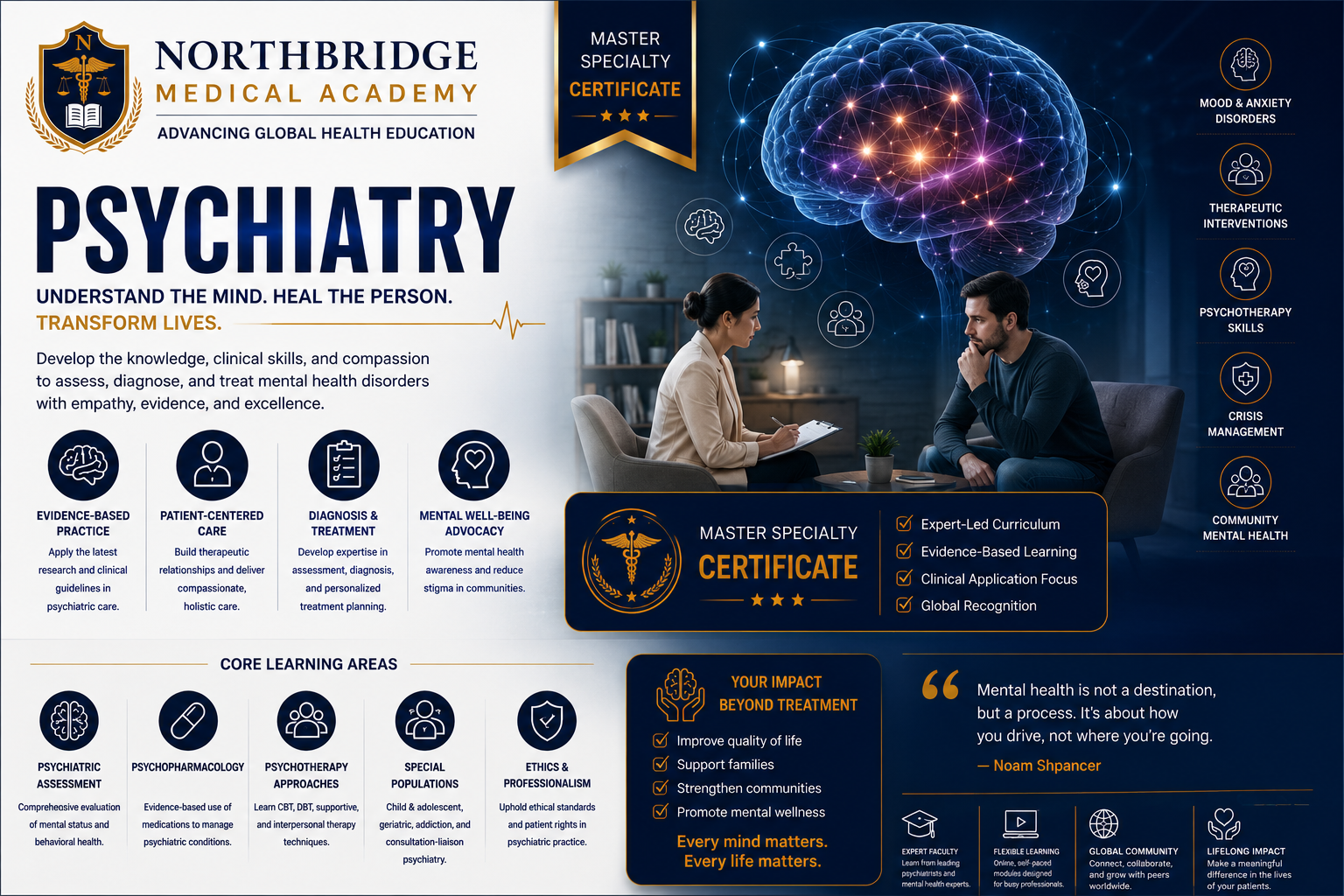
The Psychiatry Master Specialization Certificate Program is designed for healthcare professionals, mental health practitioners, researchers, educators, and individuals seeking advanced knowledge in psychiatric sciences. This flexible, self-paced program allows participants to begin their studies at any time and progress according to their own schedule.
Upon successful completion of the program requirements, participants will receive a Master Specialization Certificate in Psychiatry. Digital certificates are typically issued within one week of program completion.
Program Overview
Psychiatry is a medical specialty focused on the assessment, diagnosis, treatment, prevention, and rehabilitation of mental, emotional, and behavioral disorders. This program provides a comprehensive overview of contemporary psychiatric practice, integrating biological, psychological, social, and cultural perspectives of mental health.
Participants will explore major psychiatric disorders, diagnostic frameworks, psychopharmacology, psychotherapy approaches, risk assessment, ethical considerations, and emerging developments in psychiatric research and clinical care.
Learning Outcomes
Upon successful completion of this program, participants will be able to:
- Understand the foundations and evolution of modern psychiatry.
- Explain the biological, psychological, and social determinants of mental health.
- Identify major psychiatric disorders and diagnostic criteria.
- Understand psychiatric assessment and clinical interviewing techniques.
- Evaluate treatment approaches including psychopharmacology and psychotherapy.
- Analyze psychiatric emergencies and crisis intervention strategies.
- Recognize ethical and legal considerations in psychiatric practice.
- Apply evidence-based approaches to psychiatric care.
- Understand psychiatric care across different age groups and populations.
- Evaluate emerging trends and future developments in mental health services.
Curriculum
Module 1: Introduction to Psychiatry
- History and development of psychiatry
- Scope of psychiatric practice
- Modern mental healthcare systems
Module 2: Foundations of Mental Health and Mental Illness
- Concepts of mental health
- Psychological well-being
- Models of mental illness
Module 3: Psychiatric Assessment and Clinical Interviewing
- Patient evaluation
- Mental status examination
- Diagnostic interviewing techniques
Module 4: Classification and Diagnosis of Mental Disorders
- DSM framework
- ICD framework
- Diagnostic decision-making
Module 5: Neurobiology of Psychiatric Disorders
- Brain structure and function
- Neurotransmitters and mental health
- Biological basis of psychiatric illness
Module 6: Mood Disorders
- Major depressive disorder
- Bipolar disorders
- Assessment and management strategies
Module 7: Anxiety and Stress-Related Disorders
- Generalized anxiety disorder
- Panic disorder
- Trauma and stress-related conditions
Module 8: Psychotic Disorders
- Schizophrenia spectrum disorders
- Delusional disorders
- Early intervention approaches
Module 9: Personality Disorders
- Personality development
- Classification of personality disorders
- Clinical management strategies
Module 10: Substance Use and Addictive Disorders
- Addiction science
- Substance-related disorders
- Prevention and treatment approaches
Module 11: Psychopharmacology
- Principles of psychiatric medications
- Antidepressants
- Antipsychotics
- Mood stabilizers
- Anxiolytics
Module 12: Psychotherapy in Psychiatry
- Cognitive Behavioral Therapy (CBT)
- Psychodynamic approaches
- Interpersonal therapies
- Integrative psychotherapy models
Module 13: Psychiatric Emergencies and Crisis Intervention
- Suicide risk assessment
- Self-harm management
- Acute psychiatric crises
- Emergency response planning
Module 14: Special Populations in Psychiatry
- Child and adolescent psychiatry
- Geriatric psychiatry
- Women’s mental health
- Community psychiatry
Module 15: Ethics, Law, and Future Directions in Psychiatry
- Ethical principles in psychiatric care
- Mental health legislation
- Human rights and patient advocacy
- Emerging trends in psychiatry and mental health services
Student Learning Pack: Psychiatry
This course includes structured student-facing learning content in mental health and behavioral sciences. The purpose is to help learners move beyond a simple curriculum list and engage with concepts, case reasoning, self-check questions, assignments and portfolio evidence.
What Students Will Learn
- Understand the professional language and key concepts of Psychiatry.
- Recognize common presentations and important safety concerns.
- Use structured reasoning rather than isolated memorization.
- Prepare professional case summaries and learning notes.
- Develop portfolio evidence for certificate completion.
Core Study Areas
- clinical interview
- case formulation
- risk assessment
- therapeutic communication
- ethical boundaries
- referral pathways
Tools and Frameworks
- mental state examination overview
- risk screening
- case formulation
- safety plan overview
- progress monitoring
Deep Study Notes
A serious learner in Psychiatry should begin with definitions, then move to mechanisms, presentations, assessment logic, safety boundaries and professional documentation. The student should not only remember facts; the student should learn how those facts are used in clinical or professional reasoning.
In this course, the learner should connect the subject with real situations such as low mood, anxiety, sleep disturbance, avoidance, substance use concern, self-harm concern. Each situation should be analyzed by asking: what is the main problem, what information is missing, what findings increase urgency, which tools are appropriate, and how should the case be documented?
Applied Case Study
A client reports severe distress, poor sleep and safety concerns. The learner must structure assessment, identify risk and prepare urgent referral documentation.
Student task: write a 250–400 word case analysis including the main issue, relevant context, possible explanations, safety concerns, useful tools, and a safe next step.
Red Flags and Safety Boundaries
- active suicidal intent
- risk to others
- psychosis with risk
- safeguarding concern
Students must understand that certificate education supports learning but does not authorize independent medical practice, specialist activity, diagnosis, treatment or procedure performance outside legal and supervised professional authority.
Self-Check Questions
- What are the five most important terms in this course?
- Which common presentation should a learner recognize first?
- Which finding would make the situation urgent?
- Which tool, test or framework helps organize the case?
- What common mistake should a learner avoid?
- How would you explain one topic to a non-specialist?
- What should be included in professional documentation?
- What evidence should be saved for the final portfolio?
Assignments and Portfolio Evidence
- Key terms table with at least ten professional definitions.
- One case-based short answer assignment.
- One patient-friendly or non-specialist explanation.
- One safety and red flag reflection.
- Final learning summary explaining responsible use of the course knowledge.
Complete Student Learning Pack
This program includes a structured learning layer for Psychiatry. Students are expected to study the concepts, complete case-based tasks, answer self-check questions and prepare portfolio evidence. The purpose is to create a substantial learning experience, not a simple certificate page.
What Students Will Learn
- Describe lesions using professional terminology
- Differentiate common rash patterns
- Recognize urgent dermatological warning signs
- Prepare dermatology case summaries
- Explain skin conditions clearly to patients
Core Knowledge Areas
- Skin anatomy and lesion morphology
- Eczema, psoriasis, acne and inflammatory dermatoses
- Bacterial, viral and fungal skin infections
- Pigmentary, hair and nail disorders
- Skin cancer warning signs and documentation
Professional Tools
- lesion morphology table
- skin examination checklist
- photographic documentation
- dermoscopy awareness
- referral note
Deep Study Notes
A serious learner in Psychiatry should begin with terminology and foundations, then move into applied reasoning. Each concept should be studied through definition, mechanism, presentation, assessment, limitation, communication and documentation.
Students should avoid passive reading. For every major topic, they should ask: What is the central issue? What information is missing? What finding would make the case urgent? Which tool or framework helps organize the problem? What should be written in a professional note?
Case-Based Learning
Case 1: A patient presents with an itchy scaly rash on the elbows and scalp. The learner must describe morphology, consider differential diagnosis and write a structured dermatology note.
Case 2: A second scenario includes uncertainty or possible risk. The learner must identify what should not be assumed, what requires supervision or referral, and how to communicate the issue responsibly.
Case 3: A non-specialist asks for a simple explanation of a key topic. The learner must explain the subject clearly without giving unsafe medical instructions.
Student output: write at least one 250–400 word case analysis using professional terminology and safe reasoning.
Finding–Meaning–Next Action Table
| Finding or Topic | Possible Meaning | Professional Next Action |
|---|---|---|
| Common presentation | May indicate a routine or serious condition depending on context. | Collect structured history, assess severity and document clearly. |
| Red flag | May indicate urgency or need for qualified review. | Escalate, refer or seek supervision according to local protocols. |
| Uncertain result or conclusion | May be misleading if interpreted without context. | State uncertainty, request review and avoid overclaiming. |
Red Flags and Safety Boundaries
- rapidly spreading painful rash
- mucosal blistering
- changing pigmented lesion
- fever with extensive skin peeling
Students must understand that continuing education supports learning but does not authorize independent diagnosis, treatment, procedures, specialist practice or clinical decision-making beyond their actual legal and professional authority.
Self-Check Questions
- What are the five most important terms in this program?
- Which common presentation should a learner recognize first?
- Which finding would make the situation urgent?
- Which tool, test or framework helps organize the case?
- What common mistake should a learner avoid?
- How would you explain one topic to a non-specialist?
- What should be included in professional documentation?
- What evidence should be saved for the final portfolio?
Assignments and Final Portfolio
- Prepare a key terms table with at least ten professional definitions.
- Write one case-based short answer assignment.
- Write one patient-friendly or non-specialist explanation.
- Complete a red flag and safety reflection.
- Prepare a final learning summary explaining responsible use of the course knowledge.
Complete Student Learning Pack
This program includes a structured learning layer for Psychiatry. Students study the concepts, complete case-based tasks, answer self-check questions and prepare portfolio evidence. The purpose is to create a substantial learning experience, not a simple certificate page.
What Students Will Learn
- Recognize common cancer warning signs
- Explain screening and staging in educational terms
- Interpret oncology information cautiously
- Prepare referral-oriented case summaries
- Communicate uncertainty and support needs
Core Knowledge Areas
- Cancer biology and warning signs
- Screening and early detection concepts
- Staging and pathology report awareness
- Treatment pathway overview and referral logic
- Patient communication and supportive care
Professional Tools
- red flag checklist
- screening concept map
- pathology report review
- staging awareness table
- oncology referral note
Deep Study Notes
A serious learner in Psychiatry should begin with terminology and foundations, then move into applied reasoning. Each concept should be studied through definition, mechanism, presentation, assessment, limitation, communication and documentation.
For every major topic, students should ask: What is the central issue? What information is missing? What finding would make the case urgent or professionally sensitive? Which tool or framework helps organize the problem? What should be written in a professional note?
Case-Based Learning
Case 1: A patient has unexplained weight loss and a persistent enlarging lymph node. The learner must identify cancer warning signs, list missing information and prepare a safe referral summary.
Case 2: A pathology report contains suspicious terminology. The learner must identify what can be understood educationally and what requires specialist review.
Case 3: A non-specialist asks for a simple explanation of a key topic. The learner must explain the subject clearly without giving unsafe medical instructions.
Student output: write at least one 250–400 word case analysis using professional terminology and safe reasoning.
Finding–Meaning–Next Action Table
| Finding or Topic | Possible Meaning | Professional Next Action |
|---|---|---|
| Common presentation or academic issue | May indicate a routine learning point or a more serious professional concern depending on context. | Collect structured information, assess relevance and document clearly. |
| Red flag, ethical issue or uncertainty | May indicate urgency, supervision need, academic risk or professional limitation. | Escalate, refer, revise or seek qualified review according to local standards. |
| Unsupported conclusion | May mislead learners, patients, reviewers or institutions. | State uncertainty, add evidence, request review and avoid overclaiming. |
Red Flags and Safety Boundaries
- unexplained weight loss with mass
- persistent abnormal bleeding
- spinal cord compression warning signs
- neutropenic fever concern
Students must understand that continuing education supports learning but does not authorize independent diagnosis, treatment, procedures, specialist practice, academic misrepresentation or clinical decision-making beyond their actual legal and professional authority.
Self-Check Questions
- What are the five most important terms in this program?
- Which common problem or scenario should a learner recognize first?
- Which finding, weakness or risk would make the situation more serious?
- Which tool, test, framework or checklist helps organize the work?
- What common mistake should a learner avoid?
- How would you explain one topic to a non-specialist?
- What should be included in professional documentation?
- What evidence should be saved for the final portfolio?
Assignments and Final Portfolio
- Prepare a key terms table with at least ten professional definitions.
- Write one case-based short answer assignment.
- Write one patient-friendly, student-friendly or non-specialist explanation.
- Complete a safety, ethics or red flag reflection.
- Prepare a final learning summary explaining responsible use of the course knowledge.
Course Content
Module 1: Course Orientation and Professional Scope
-
How to Study This Certificate Program
-
Professional Scope and Responsible Certificate Use
-
Building Your Learning Portfolio
Module 2: Foundations and Key Concepts
Module 3: Assessment and Structured Reasoning
Module 4: Core Knowledge Areas
Module 5: Applied Practice and Case-Based Learning
Module 6: Communication and Documentation
Module 7: Safety, Ethics and Professional Limits
Module 8: Assessment Workbook and Final Portfolio
Student Ratings & Reviews